




cosys E/P Regulators: Signal, Sizing and Calibration Guide
Most E/P regulator problems trace back to one of three things: the wrong signal type, a supply pressure that barely clears the output range, or an exhaust port that someone capped off. None of these show up on the datasheet comparison, so it is worth ten minutes before ordering to sort them out.
Match the signal first
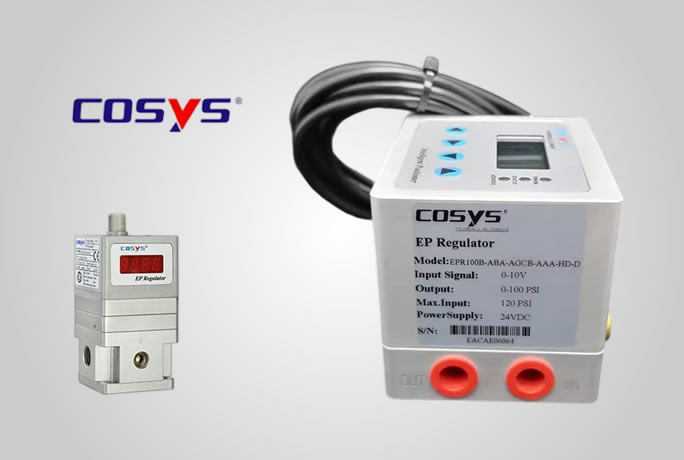
The P8K series (for example the P8K-X50-35G2-0V) converts an electrical setpoint into proportional output pressure, which lets the PLC move clamping force, tension or test pressure around without anyone touching a knob. What matters is that the input signal and the controller actually agree:
| Input signal | Typical home | Watch out for |
|---|---|---|
| 0–10 V | Standalone analog cards, bench rigs | Voltage drop over long runs — keep cable runs short or use screened cable |
| 4–20 mA | Process controllers, long cable runs | Live-zero means 4 mA is a valid setpoint, not a broken wire |
| Fieldbus / digital | Modern PLC I/O, remote setpoints | Check the module resolution; 8-bit cards make fine pressure steps impossible |
Before you order
Pick a span where the normal working point sits mid-range — accuracy falls off near the ends of any regulator.
Supply pressure needs comfortable headroom above the maximum output, not just "enough".
Check the regulated flow covers the actuator refill demand; an undersized unit sags exactly when the load moves.
Decide manifold versus in-line mounting now, not during installation week.
Two field notes that save an afternoon
Oscillating output: nine times out of ten it is downstream compliance interacting with the control loop, or a PID that was tuned for a manual regulator. Adding a small buffer volume usually settles it faster than retuning the loop.
Slow, drifting output: check the 5–40 µm supply filter first — a loaded element starves the pilot orifice — then look at the exhaust vent. A blocked or throttled exhaust destabilises regulation on its own. These units are otherwise solid-state; an annual calibration check on critical loops is all the service they really need.