





STOBER Gear-Motors and Servo Drives: Sizing and Commissioning Guide
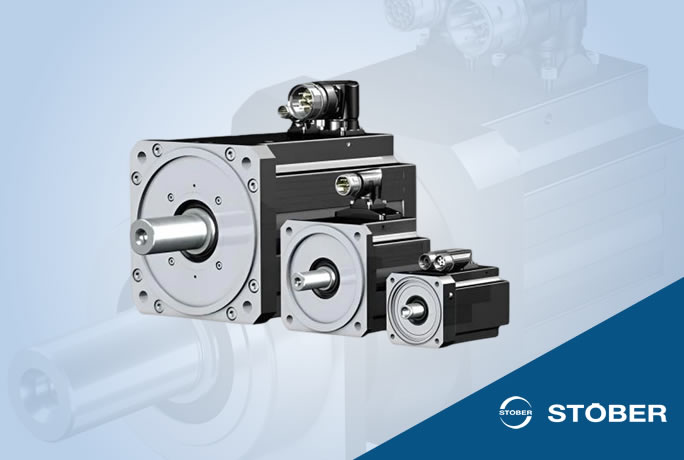
Let's say a packaging machine needs a 90° index axis: 40 Nm peak torque, 90 rpm peak, roughly 300 Nm² of reflected load inertia. That single line of the motion profile decides almost everything, so start there rather than in a catalogue.
The inertia ratio is the number that decides whether the axis will tune up nicely or fight you. STOBER gear units are stiff and low-backlash, so ratios around 5–10:1 are comfortable to tune — much above that and the servo loop starts oscillating no matter how good the motor is. Dividing 300 Nm² by a ratio of 10:1 gives roughly 3 Nm² at the motor shaft, which a compact servo motor handles with room to spare.
Gear family follows from the mechanical layout:
Helical in-line — highest efficiency, quiet, the default for straight-through shafts.
Bevel — when the axis turns a corner and you want to keep the efficiency.
Planetary — when space is tight but torque density and stiffness matter most.
With torque, speed, ratio and gear family settled, pick the motor on continuous versus peak duty from the motion profile — a fast indexing axis lives on its peak rating, a holding axis on the continuous one. Feedback resolution is chosen by the positioning accuracy the machine promises: keep the encoder resolution at least an order of magnitude finer than the target accuracy.
Commissioning, briefly
Set the motor, encoder and brake parameters, then spin the axis at low speed before any product is in the machine. Tune gains against the real load inertia — values tuned with the brake locked or the load removed will oscillate the moment the machine runs. Configure ramp times and torque limits to protect the mechanism, and keep the STOBER commissioning software's project backup on file; it turns a controller swap from a day of guessing into a fifteen-minute restore. After that, the only routine items are the gear unit's lubrication interval, the brake gap, and a glance at fault logs for overload or overheating trends.