


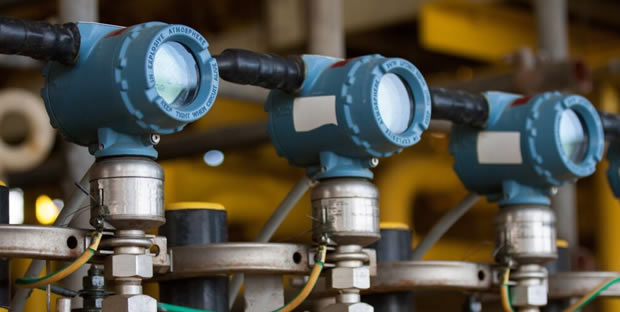


What is the difference between pressure switch and pressure sensor?
What is the difference between a pressure switch and a pressure sensor? How to make a selection between them?
Pressure Switches
A pressure switch is a device used to detect and control the pressure of liquids or gases. It typically consists of an adjustable mechanical spring and an electrical switch. When the pressure of the measured medium exceeds or falls below a preset threshold, the pressure switch triggers a switching action, thereby achieving pressure control.
Pressure Protection: When the pressure of the measured medium exceeds the preset upper limit or falls below the preset lower limit, the pressure switch triggers a switching action to protect the equipment from the effects of excessively high or low pressure.
Pressure Control: By adjusting the threshold of the pressure switch, it is possible to control the pressure of the measured medium, ensuring that the system operates within a safe range.
Alarm Signaling: The pressure switch can send an alarm signal by triggering a switching action to alert operators or other equipment of abnormal conditions.
A pressure sensor is a device used to measure the pressure of liquids or gases. It typically consists of a sensing element, a signal processing circuit, and an output interface. The sensing element can be of various types, such as piezoresistive, piezoelectric, or capacitive, and is used to convert pressure into an electrical signal.
Pressure Monitoring: The pressure sensor can continuously monitor changes in the pressure of the measured medium and convert them into corresponding electrical signals for subsequent processing and analysis.
Process Control: By connecting to a control system, the pressure sensor can achieve precise control of the pressure of the measured medium to meet process requirements.
Data Acquisition: The pressure sensor can transmit pressure data to a data acquisition system for analysis and recording, facilitating subsequent data processing and decision-making.
How Do They Work?
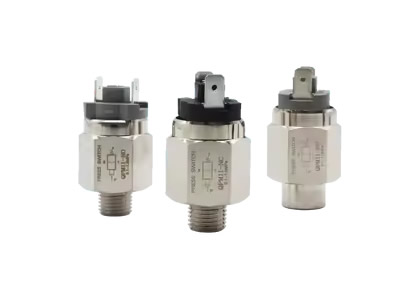
Pressure Switches
A pressure switch is a device that monitors and controls pressure in industrial systems by opening or closing a circuit once a specified pressure level is reached.
Sensing: Pressure switches use sensing elements such as diaphragms or pistons to detect changes in gas or fluid pressure.
Switching: When the predefined pressure is reached, the sensing element activates a switch, opening or closing a circuit.
Control: This switching action can control various functions, such as starting/stopping pumps, adjusting compressors, or triggering safety alarms.
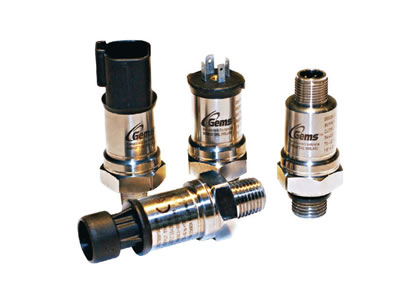
Pressure Sensors
A pressure sensor (also known as a pressure transducer or pressure transmitter) measures the pressure of a gas or fluid and converts it into an electrical signal, typically received by a PLC or controller.
Sensing: Pressure sensors measure the force exerted by the media on a sensing element, often a diaphragm.
Conversion: This force is converted into an electrical signal (voltage or current) sent to a control system, such as a PLC.
Control: The signal transmitted to a control system enables automated monitoring or control of processes, based on measured pressure.
Key differences between pressure switches and pressure sensors
| Feature | Pressure Switches | Pressure Sensors |
| Functionality | On/off control - opens or closes a circuit | Continuous pressure measurement |
| Output | Binary output (above / below threshold) | Continuous analogue or digital signal (e.g. 4-20mA, 0-10 V) |
| Applications | Simple control systems | Advanced monitoring and control system |
| Types | Mechanical or electrical | Diaphragm, capacitive, piezoresistive, etc |
| Cost | Simpler design - lower cost | Higher cost due to increased functionality |