



Kuebler Sendix Encoder Selection: Five Steps from Shaft to Signal
Kuebler's Sendix encoder line spans everything from a 24-hour-delivery incremental workhorse to ATEX absolute encoders for offshore duty, and the product finder can feel overwhelming the first time you open it. Working through the choice as five ordered steps keeps the decision tree short and, more importantly, in the right order - because each step eliminates options that the next step would otherwise waste time on.
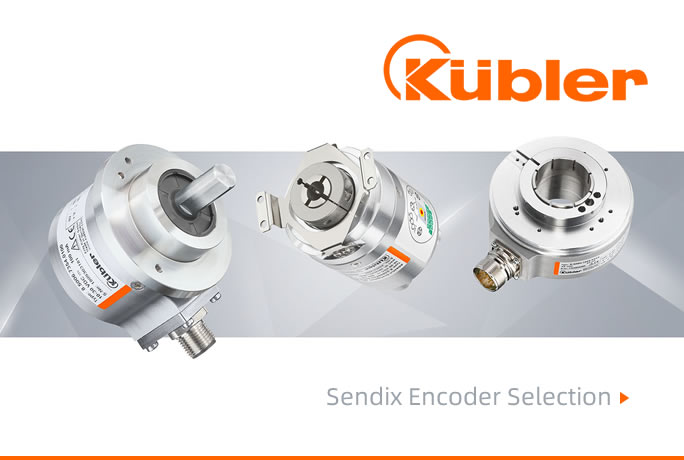
Five steps to the right Sendix
Decide incremental or absolute first. If the drive only needs speed, position within one revolution after homing, or a simple length count, an incremental encoder is enough - the Sendix 5000 / 5020 series gives up to 5,000 ppr in a 58 mm housing with TTL, RS-422 (HTL push-pull) or open-collector outputs. If the controller must know the shaft angle immediately after power-up without a homing run, go absolute: the Sendix 7000 family resolves up to 16 bits singleturn with SSI, CANopen or EtherCAT/CAN interfaces.
Match the shaft and flange. The 5000 / 5020 series accepts solid shafts from 6 mm up to 12 mm (with flat surface) or 3/8 in, on synchro, servo, clamping or square flanges. For motors with a through-shaft, the SinCos incremental 5814 / 5834 series covers hollow shafts from 10 mm to 15 mm (and 1/2 in) and spins up to 12,000 min-1 - the usual pick as motor feedback in drive technology. Bearingless ring types (RIM2000 / RIM5000) skip the shaft connection entirely for large diameters.
Pick the signal quality you actually need. Standard TTL / RS-422 signals are fine for counters and PLC high-speed inputs. Where the drive interpolates position from the signal - servo amplifiers, for instance - the SinCos variants of the 5814 / 5834 with their very high signal quality are worth the premium, because interpolation resolution depends on signal cleanliness, not on ppr alone.
Check the environment, not the brochure hero. Standard 5000-series units are rated IP66 / IP67 and -40 to +85 degrees C; stainless-steel 5006 / 5026 versions add material resistance for washdown and corrosive duty. For hazardous zones, the Sendix 7058 / 7078 come in a 70 mm pressure-resistant housing of seawater-resistant aluminum with ATEX / IECEx flameproof approval and CANopen output - the standard choice on maritime and offshore applications.
Close the order with mounting hardware. Hollow-shaft encoders need a stator coupling (part 8.0010.1602.0000 for 50-58 mm flanges) or a flexible fastening arm for high-dynamic drives; a bearing box offloads side loads from solid-shaft units. Kuebler's own M12 and M23 cordsets, plus the Codix display/counter family if a local reading is wanted, are all in the same docu-finder - ordering them with the encoder saves a second delivery cycle.
One practical note from the factory floor: the 5000 and 5020 series carry Kuebler's Safety-Lock bearing design, which tolerates vibration and small installation errors far better than plain bearings - on long-running machines, that alone has settled more encoder debates than any resolution figure. And since Kuebler builds the popular variants to stock, a same-day order commonly ships within 24 hours, which is worth remembering when a failed encoder has a production line waiting.