




VSS or VSH? Matching a Phytron Stepper Motor to Vacuum, Cryogenic or Radiation Duty
Putting an ordinary stepper motor inside a vacuum chamber is a classic way to ruin an experiment: the insulation varnish, grease and adhesives keep outgassing for weeks, the chamber never reaches its target pressure, and in cryogenic service the motor simply stops turning. The Phytron VSS and VSH two-phase hybrid steppers were designed for exactly this problem, with vented rotors, vacuum-compatible insulation and baked-out materials, in flange sizes from 19 mm up to 125 mm.
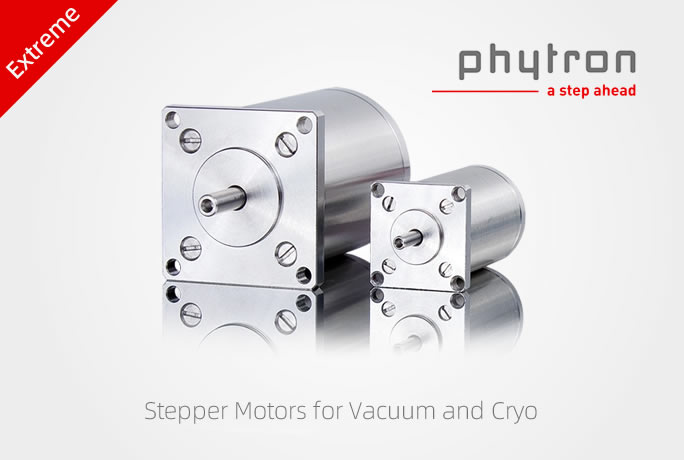
The two families share the same electrical logic — 200 full steps per revolution (1.8°), bipolar windings, phase currents from 0.6 A up to 10 A, holding torque from 3.4 mNm on the smallest VSS up to 13 Nm on the largest VSH — so the real selection decision is not size first, it is the vacuum grade suffix. That suffix decides the materials, the outgassing behaviour, the temperature window and the radiation tolerance, and ordering a lower grade "because it is cheaper" usually means re-ordering once the chamber cannot pump down.
Vacuum grades at a glance: FV, HV, UHV, UHVC
| Grade suffix | Ultimate vacuum | Working temperature | Radiation tolerance | Typical duty |
|---|---|---|---|---|
| FV (rough vacuum) | 10-3 hPa | -20 to +150 °C | 104 J/kg | Coating rigs, small industrial chambers, leak-test equipment |
| HV (high vacuum) | 10-7 hPa | -20 to +200 °C | 105 J/kg | E-beam evaporation, sputtering, optical vacuum platforms |
| UHV (ultra high vacuum) | 10-11 hPa | -20 to +300 °C | 106 J/kg | Semiconductor wafer tools, accelerators, UHV optics |
| UHVC (cryogenic UHV) | 10-11 hPa | -270 to +40 °C | 106 J/kg | Liquid nitrogen / liquid helium cryostats, cold sample stages |
Three quick checks settle most orders:
Bake-out temperature — the grade's upper limit is also the bake-out ceiling. If your chamber bakes at 250 °C, a HV unit rated to 200 °C is the wrong order, whatever its vacuum class.
Outgassing specification — optical coating and semiconductor work cares about condensables, not just pressure. The vacuum versions use low-outgassing materials (total mass loss under 1%), and if a spec sheet cites ECSS limits, quote the requirement back to the supplier instead of assuming.
Cooling reality — in vacuum there is no convection. Continuous duty needs the manufacturer's derating curve for reduced winding current, or a thermally conductive mounting plate; a motor that is fine in air will cook in a chamber at the same current.
Beyond the vacuum suffix, the usual options apply to both families: VGPL planetary or harmonic gears, KTC/Pt100 winding sensors, encoders, double shafts, and vacuum-rated 4-lead cabling for feedthrough wiring. Radiation ratings matter in accelerator and space-adjacent work — the UHV grades tolerate around 106 J/kg — and a Space variant with reinforced construction is available for high shock and vibration. If the motion is linear rather than rotary, Phytron builds the LA cryogenic linear actuator family on the same vacuum discipline, so the grade logic carries over.