





A Photoelectric Sensor Is Bought Twice: Six Checks That Prevent the Second Purchase
A photoelectric sensor on a conveyor is usually bought twice: once on price and sensing distance, then again after it starts missing dark trays or double-counting shrink wrap. The parameters that cause the second purchase are rarely in the headline specification. They are in the geometry of the beam, the surface of the part and what sits behind it. Six checks, done in this order, decide the part before anyone presses a teach button.
The order matters more than the answers
Decide what the beam has to do. Three jobs look similar on a drawing and behave nothing alike. Through-beam sensing uses a separate emitter and receiver facing each other and detects the part by breaking the beam; it is the most forgiving arrangement and reaches the longest distances. Retro-reflective sensing puts emitter and receiver in one housing and bounces the beam off a reflector, so only one side of the conveyor needs wiring. Diffuse sensing reads light returning from the part itself, with no reflector at all. Choose the arrangement from the mechanical layout first, then look for a sensor inside it.
Look at the part surface before the part size. A diffuse sensor's range is quoted for a reference target, and that reference is usually a matt white surface. A black rubber part, a glossy aluminium can and a clear PET bottle all return a fraction of that light, and a clear bottle may return almost none in a straight diffuse arrangement. If colour, gloss or transparency changes across the product mix, through-beam or background suppression is the safer family, because the detection event stops depending on how much light the part happens to reflect.
Measure the distance to whatever sits behind the target. Diffuse sensors without background suppression will happily see the stainless back plate of the conveyor frame, and the symptom is a sensor that stays on all shift. Background suppression solves this by triangulating, so the switching point is set at a distance and anything beyond it is ignored, but the technology needs a minimum separation between target and background, and it has a close-range dead zone in front of the lens. If the part runs 5 mm in front of a frame, check the dead zone before ordering.
Confirm that both mounting points exist. Through-beam needs a bracket on each side, aligned, and the alignment must survive vibration and cleaning. Retro-reflective needs a reflector mounted firmly opposite the lens; a reflector that flexes by a millimetre on a vibrating frame will drop the signal. Both arrangements collect dust and washdown residue on two optical surfaces instead of one, which is a maintenance cost that the data sheet does not show.
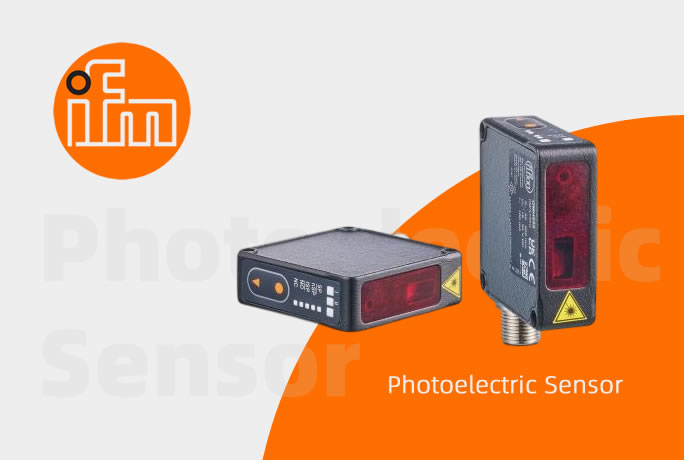
Check the beam against the smallest feature you must see. A beam wider than the gap between two parts cannot count them separately, and a beam narrower than a thin edge will miss it at an angle. Where the job is a measurement rather than a presence check, switch families altogether: laser distance sensors such as ifm's OMH range are specified over a working span of tens to hundreds of millimetres with sub-millimetre repeatability, and they need a warm-up period of about twenty minutes after power-on before the published figures apply.
Match the electrical side to the controller. PNP versus NPN is decided by the PLC input card, not by preference, and a sensor with two outputs can be configured as complementary or as a window pair. Switching frequency has to clear the line speed and the part spacing with margin, since a 150 Hz output cannot count parts arriving every 3 ms. If the sensor supports IO-Link, parameter sets can be stored and pushed back after a replacement, which turns a fifteen-minute teach on a ladder into a two-minute swap.
One habit saves most of the trouble: test with the actual product, at the actual speed, with the actual background in place. Published sensing ranges are measured against a standard target under reference conditions, and the gap between that and a real conveyor is where the second purchase comes from. A sensor that reads correctly on the bench and fails on the line is usually failing at check two or check three, not at the teach step.